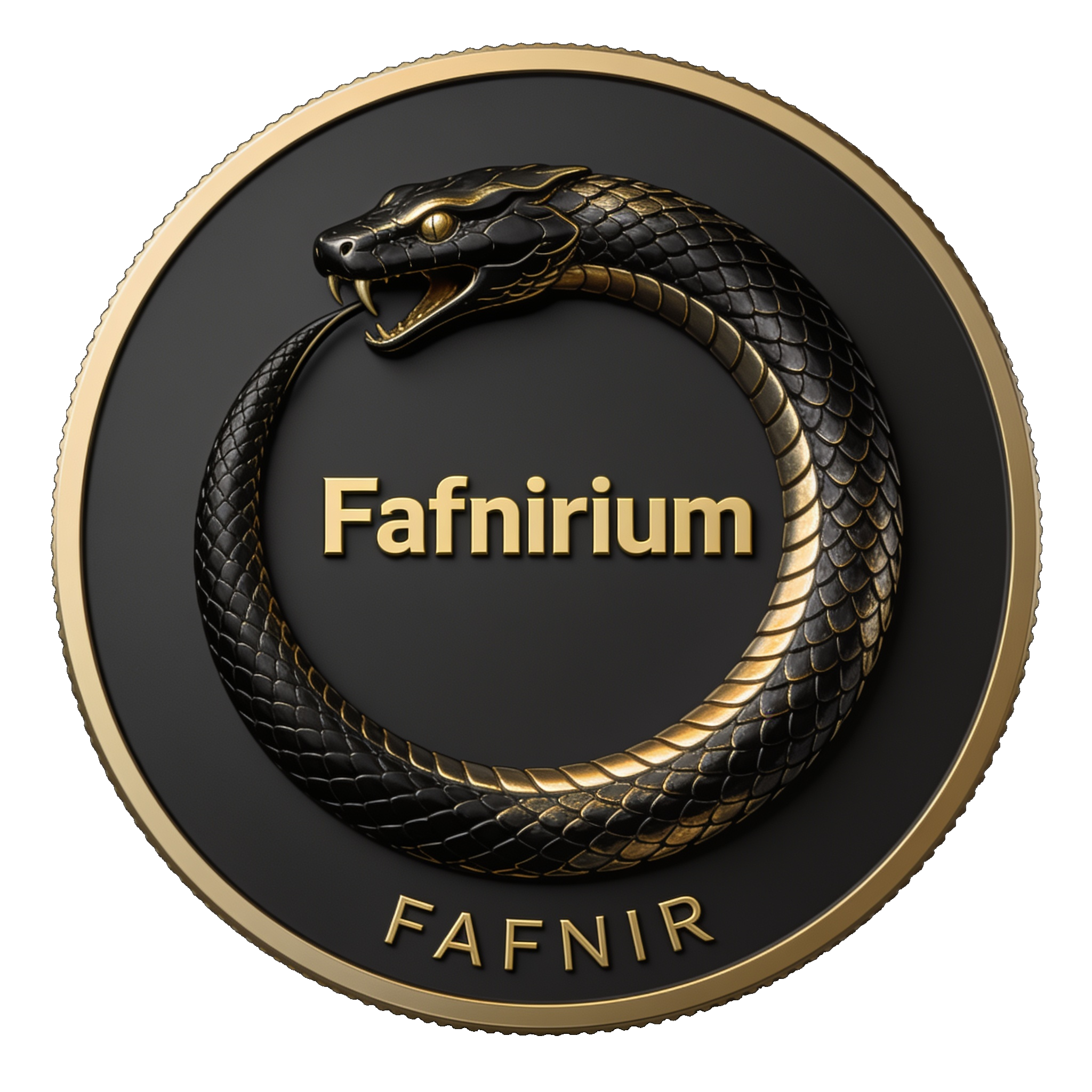
Fixed supply. No key. No keepers.
The Dragon Reigns!
210,000,000 FAFNIR. Minted once. Ownership renounced. Liquidity burned. Nothing left to control — nothing was left standing that could ever be used to control it.
0x3311AAC4A400052C2206e0D491E582E5CB1ED5CEThe only official contract address. Verification is encouraged before trusting anything else.
Live Price
The Myth
Fafnir the Dragon
In Norse legend, Fafnir was a man consumed by greed for a cursed hoard — so consumed that he became a dragon to guard it. Forever hoarding. Trusting no one. Bound to the treasure he coveted, for as long as the story is told.
A cautionary tale, and one that hasn't aged out of relevance. Fafnir wasn't born a dragon. He was a man who let a pile of gold rewrite what he was — who convinced himself that guarding the hoard mattered more than anything he might have been otherwise. That's not just a myth about greed in the abstract. It's a decent description of how a lot of financial institutions actually behave.
The money sits behind opaque walls, and its keepers ask the public to trust that it's there, that it's managed responsibly, that their claim on it is honored — with no way to check any of it themselves. Rules change after the fact, in the institution's favor, whenever it suits them. Access is gated, terms are rewritten in fine print no one reads, and the people guarding the treasure answer mainly to themselves. Like Fafnir, the point stops being what the gold is for and becomes the hoarding itself.
Fafnirium borrows that ancient meme, to promote the cautionary tale's wisdom. A dragon's hoard is usually a secret, kept from the world, guarded by someone who answers to no one. Fafnirium is the opposite: a supply that's fixed, open to all, and completely visible — to everyone, from the first block. Guarded by nothing but code that can't change its mind.
Crypto Has Its Own Fafnirs
Here's the uncomfortable part: crypto was supposed to be the answer to Fafnir, not another retelling of him.
Meme coins launch with quiet mint functions, so the supply everyone was promised is fixed can be inflated later — often justified as "marketing budget" or "team allocation," decided unilaterally, after people already bought in believing the hoard was sealed. Liquidity gets seeded just deep enough to look credible, then pulled the moment enough people have bought in — the LP tokens never burned, just quietly walked back out the door by whoever controlled them the whole time. Ownership renouncement, when it happens at all, often turns out to be theater: a backdoor left in, an "admin" function renamed to look harmless, a second wallet with the same powers as the first.
None of this needs a cursed ring or a Norse curse to explain. It's the same transformation Fafnir underwent — someone deciding the hoard is theirs to guard, theirs to move, theirs to redefine, regardless of what anyone was told at the start. The tools changed. The story didn't.
It didn't have to go this way, and it doesn't have to stay this way. Bitcoin's founding idea was never "trust me" — it was "you don't have to." A fixed, disclosed supply. No central party who could quietly change the rules. A ledger anyone could audit instead of a promise anyone had to take on faith. That was the whole point, before wrapped tokens, opaque treasuries, and quietly-adjustable mint functions crept back in wearing decentralization's name.
Fafnirium borrows from those original tenets on purpose. Not as nostalgia, but as a small, verifiable proof that the model still works exactly as designed when nobody carves out an exception for themselves. If it can be a rallying point for anything, it should be this: a reminder that "trustless" was supposed to mean something specific and checkable, not a marketing word slapped onto whatever launches this week. The industry doesn't need another mascot. It needs more projects willing to give up the exact powers Fafnir refused to.
Fafnirium exists partly as a direct answer to that pattern, not just the old-world one. No mint function, at all, ever. Liquidity burned, verifiably, at a real address anyone can check. Ownership renounced, confirmed on-chain, with the transaction published below rather than asserted. None of this is a promise about what the deployer will do — it's a description of what's no longer technically possible for the deployer, or anyone, to do.
What Fafnirium Is
210,000,000 FAFNIR. Fixed forever. No mint function exists in the contract. Not now, not later, not by the deployer, not by anyone.
A 1% per-wallet cap, enforced on-chain. No single wallet — including the deployer's — can ever hold more than 2,100,000 FAFNIR. Written into the contract itself, not a promise. This stops any one wallet from becoming a whale; it doesn't, and can't, limit how many wallets one person or entity controls, or their combined total across those wallets — see the disclosure below.
No owner. No admin key. No pause button. Ownership was renounced immediately after launch. No one — including the deployer — can change this contract, ever again.
Liquidity burned, permanently. The LP tokens from the FAFNIR/WETH pool were sent to a burn address at launch. That liquidity can never be pulled — not by the deployer, not by anyone.
Verified, public source code. Every claim here can be checked against the actual deployed contract. Verification is preferable to trust.
A Note on Deployer Holdings
The per-wallet cap prevents any single wallet from becoming a whale. It doesn't, and can't, limit how many wallets one person or entity holds, or their combined total across those wallets — that's a fact about the mechanism, not a loophole being pointed out for the first time.
The deployer may hold more than 1% of total supply in aggregate across multiple wallets, including as part of a personal or entity-level crypto holding strategy. Any tokens held by the deployer are acquired the same way as anyone else's — on the open market, no special access or discount — and each individual wallet stays under the same 1% cap as any other holder. Any wallet's balance, including wallets associated with the deployer, can be checked independently at any time on Basescan using the contract address above. This page makes no separate commitment to proactively publish or update deployer wallet addresses or holdings.
What Fafnirium Is Not
Fafnirium is not a security, an investment contract, or a promise of profit. It has no roadmap, no team token allocation, no pre-sale, and no plans beyond what's already written into the contract today. It is not connected to any other token, chain, or project — past, present, or future. If the deployer ever builds something else, it will stand entirely on its own, with no claim on Fafnirium or its holders.
This is a factual description of a deployed smart contract, not financial advice. Independent research is recommended.
By the Numbers
How to Get FAFNIR
Fafnirium trades on Uniswap on Base — no centralized exchange listing, no gatekeeper. It can be bought directly through MetaMask or Coinbase Wallet:
- 1
Set the wallet to the Base network
- 2
Have some ETH on Base ready to swap
- 3
Open the wallet's swap feature and paste the contract address:
0x3311AAC4A400052C2206e0D491E582E5CB1ED5CE - 4
Review the quote, confirm the swap
The contract address should always be verified character-by-character before swapping. This is the only official contract. Anything else is not Fafnirium.
A Note on Risk
This is a newly launched token with no admin control. That means nothing can ever be "fixed" after the fact — no bug patch, no recovery, no reversal. Liquidity, once burned, is gone forever. Prices can move sharply, especially early on, and only funds one is fully prepared to lose should ever be used.
Clear eyes are worth more than a comforting story.
Independent Verification
This page's word shouldn't be taken for any of it:
Confirm the contract's verified source code on Basescan
Confirm the contract has no owner under its read functions
Confirm total supply is exactly 210,000,000, with no mint function anywhere in the code
Confirm the max wallet cap and pool/burn exemptions directly on-chain
Confirm the liquidity burn transaction independently
The entire point of building it this way is that none of this needs to be trusted. It only needs to be checked.